Get Started
Screenshot of n8n workflow
FREE TEMPLATE
Automate YouTube Summaries for Repurposing
3
Views
0
Downloads
10
Nodes
Download Template
Free
Preview Template
Utility Rating
6 / 10
Business Function
Marketing
Automation Orchestrator
n8n
Integrations
OpenAI
Apify
Trigger Type
Webhook
Approx setup time ≈ 35 min
Need help setting up this template?
Ask in our free Futurise community
About
Community
Courses
Events
Members
Templates

How to Automate YouTube Summaries for Repurposing?

Leon Petrou
FREE TEMPLATE
Automate YouTube Summaries for Repurposing
3
Views
0
Downloads
10
Nodes
Download Template
Free
Preview Template
Utility Rating
6 / 10
Business Function
Marketing
Automation Orchestrator
n8n
Integrations
OpenAI
Apify
Trigger Type
Webhook
Approximate setup time ≈ 35 minutes
Need help setting up this template?
Ask in our free Futurise community

Description

Turn long YouTube videos into short notes your team can use. Paste a video link into a simple form and get a clear summary in minutes. Great for content teams, social managers, and anyone who needs fast insights.

The form collects the full video URL and sends it to an HTTP request that calls an Apify endpoint to fetch the transcript. That text flows into a summarization chain powered by an OpenAI model connected through the language model node. The chain pulls out main points, action items, and quotes, then hands off to a final step where you can add delivery steps later. This design keeps the flow clean and easy to extend.

Setup needs an Apify token and an OpenAI API key. Add your Apify endpoint in the HTTP request node and select your OpenAI credential in the model node. Expect viewing and note taking time to drop by a large margin, turning a 30 minute video into a 3 minute read. Use it to build content briefs, draft social captions, prep for meetings, or scan industry updates without watching every minute.

Copy link

Tools Required

OpenAI
Sign up
Pay-as-you-go: GPT-5 at $1.25 per 1M input tokens and $10 per 1M output tokens
n8n
Sign up
$24 / mo or $20 / mo billed annually to use n8n in the cloud. However, the local or self-hosted n8n Community Edition is free.
Apify
Sign up
Free plan: $0 / mo with $5 monthly platform credits; API access via token

What this workflow does?

  • Form based URL capture that creates a public webhook form for easy input
  • HTTP request posts the YouTube link to an Apify endpoint using a JSON body
  • OpenAI powered chat model node provides the language model for summaries
  • Summarization chain converts raw transcripts into clear key points and actions
  • No Operation end step lets you attach delivery nodes later without changing core logic

What are the benefits?

  • Reduce manual viewing time from 30 minutes to 3 minutes per video
  • Streamline content review by 80 percent with one form and one click
  • Cut rewrite time by 60 percent with consistent, structured summaries
  • Handle 10 times more videos each week with the same team size
  • Connect Apify and OpenAI in one flow to keep maintenance simple

How to set this up?

  1. Import the template into n8n: Create a new workflow in n8n > Click the three dots menu > Select 'Import from File' > Choose the downloaded JSON file.
  2. You'll need accounts with Apify and OpenAI. See the Tools Required section above for links to create accounts with these services.
  3. Open the Form Trigger node and set the path and title if needed. Save the workflow and activate it to get the public form URL for submitting YouTube links.
  4. Double click the HTTP Request node. In the URL field, paste your Apify actor run endpoint that returns a transcript. Keep the method as POST and confirm the JSON body includes the startUrls field with the form value.
  5. For Apify credentials, click the credential dropdown in the HTTP Request node and choose Create new credential. Follow the on screen steps to add your Apify API key and apply it to the request.
  6. Open the Summarization Engine node. In the credential dropdown, click Create new credential, then paste your OpenAI API key from the OpenAI API page. Choose your preferred model and save.
  7. Open the Summarization of a YouTube script node. Confirm it is connected to the Summarization Engine and that the input is the transcript from the HTTP Request node. If the transcript property name differs, map the correct field after a test run.
  8. Activate the workflow. Open the public form URL and submit a full YouTube link. Wait for the run to complete.
  9. Go to Executions in n8n. Check the HTTP Request node for a 200 status and visible transcript text. Review the summarization output and confirm the final step receives the summary.
  10. Troubleshoot common issues: a 401 or 403 means the API key or token is wrong, an empty transcript may mean the video is unsupported by the actor, and very long videos may need chunking settings in the summarization node.

Need help or want to customize this?

Similar Templates

n8n
Marketing
Automate YouTube SEO and Publishing
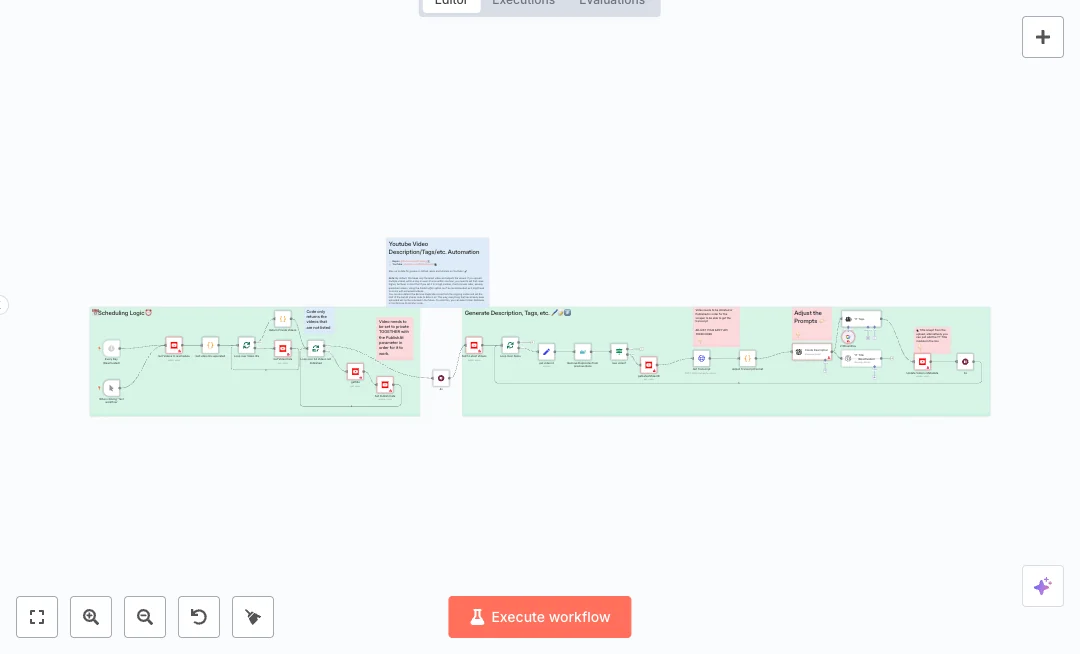
Grow your channel with less manual work. This automation finds your newest upload, writes a clear description, suggests strong tags, and updates video metadata. It also schedules private videos for publish dates so your content goes live on time. Ideal for creators, teams, and agencies that upload often and want consistent SEO. The flow runs on a daily schedule, and you can also test it on demand. It pulls recent videos from YouTube, removes repeats from earlier runs, and checks if there is a new item to process. A transcript is scraped through an API call, then formatted for clean prompts. OpenAI drafts the description and title, and Google Gemini helps generate keyword tags. The result is pushed back to YouTube, and short waits are added to avoid rate limits. A separate path scans private or not listed videos and sets the publishAt date when needed. Set YouTube OAuth, OpenAI and Google Gemini API keys, and an Apify token for the transcript call. Expect faster uploads, steady SEO quality, and fewer manual edits. This is useful for scheduled releases, daily content, or batches managed by a small team.
15 views
view
n8n
Marketing
Generate YouTube Shorts from Google Sheets
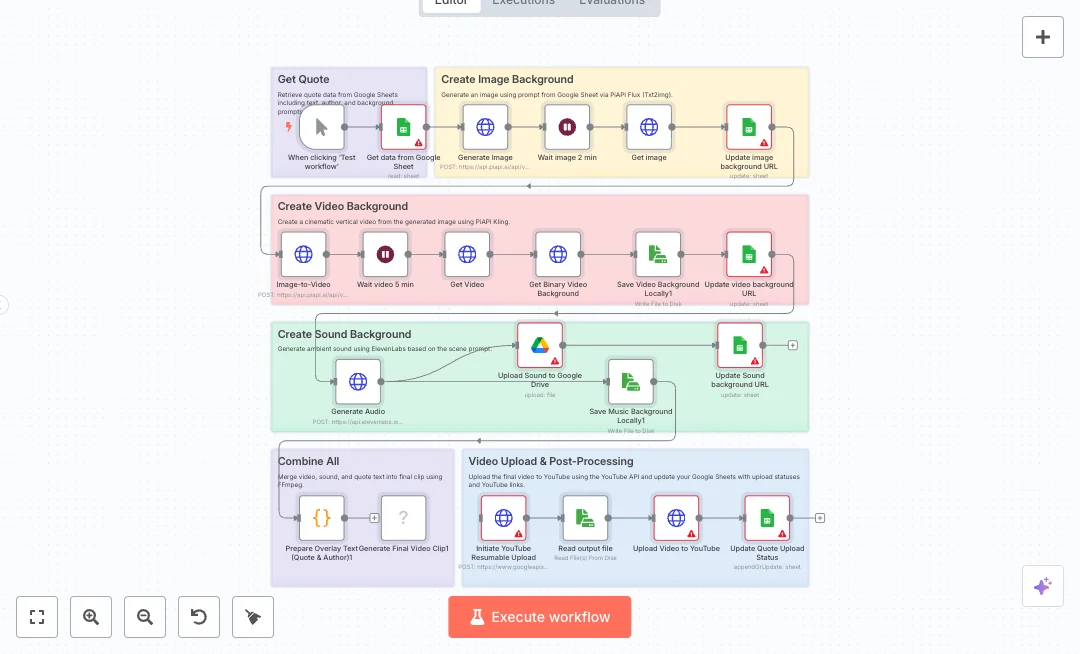
Create short videos for YouTube by pulling a quote and creative prompts from Google Sheets, building the background image and video with AI, adding ambient sound, and publishing the final clip to your channel. Great for social teams and creators who want steady content without manual editing. A manual start reads one row from Google Sheets with the quote, author, and scene prompts. The flow calls an image model to render a vertical image, waits, then writes the image link back to the sheet. It then sends that image to a video model to produce a cinematic vertical clip, waits again, downloads the file, and records the video link in the sheet. Audio is generated with a voice and sound service, stored to Google Drive, and the drive link is saved. A code node formats overlay text, then FFmpeg merges video, audio, and on screen text into a final MP4. The clip uploads to YouTube with a resumable upload, and the sheet is updated with status and the YouTube link. You will need API keys for the AI services, Google and YouTube OAuth, and FFmpeg installed on the n8n host. Expect one run to replace hours of editing with a repeatable system managed from a spreadsheet. Ideal for daily quotes, quick tips, or listicle shorts driven by your sheet.
13 views
view
n8n
Marketing
Analyze YouTube Videos for Content Insights
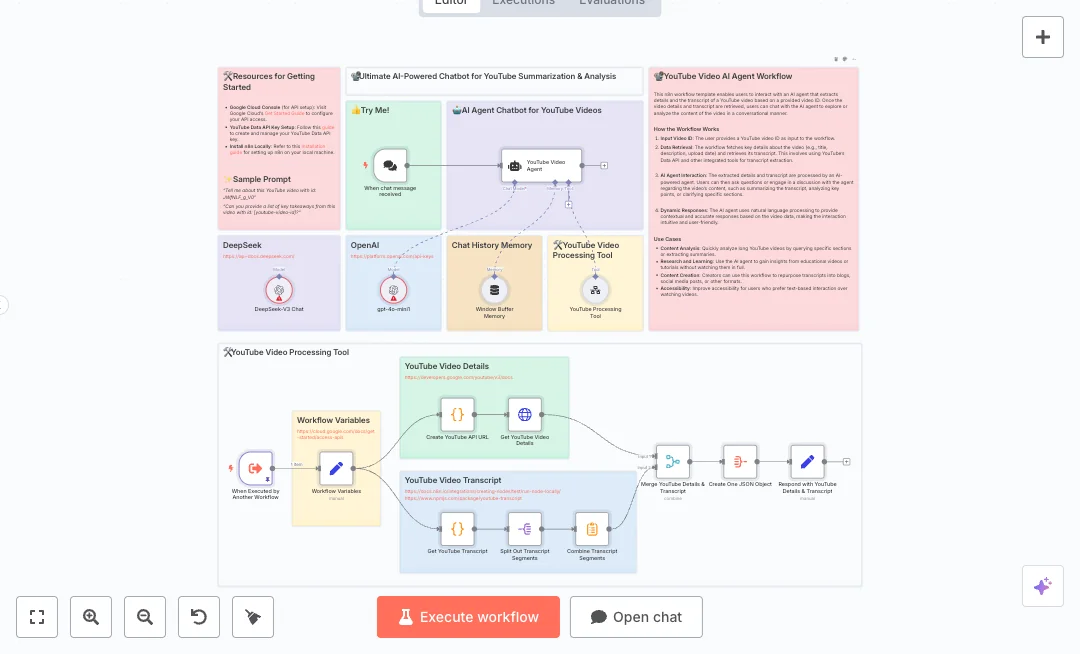
Turn any YouTube video into fast, useful insights your team can use. Enter a video ID and chat with an AI that knows the full transcript and video details. Great for content teams, researchers, and anyone who needs quick answers without watching the whole video. Behind the scenes, a chat trigger starts a conversation and keeps history so the AI remembers context. A custom tool builds a YouTube Data API request and pulls title, description, and publish date. Code also collects the video transcript, splits it into parts, and combines it into one clean text block. The workflow then merges details and transcript into one JSON object. An AI agent powered by an OpenAI model reads this data and answers questions, summarizes content, and points to key moments. To set it up, you need a YouTube Data API key from Google Cloud and an OpenAI API key. DeepSeek is optional and can be added if you want more model choices. Expect faster research, less manual viewing time, and better reuse of video content. Common uses include building summaries for blogs, pulling quotes for social posts, and reviewing long training videos in minutes.
6 views
view
See More Templates

These templates were sourced from publicly available materials across the web, including n8n’s official website, YouTube and public GitHub repositories. We have consolidated and categorized them for easy search and filtering, and supplemented them with links to integrations, step-by-step setup instructions, and personalized support in the Futurise community. Content in this library is provided for education, evaluation and internal use. Users are responsible for checking and complying with the license terms with the author of the templates before commercial use or redistribution.Where an original author was identified, attribution has been provided. Some templates did not include author information. If you know who created this template, please let us know so we can add the appropriate credit and reference link. If you are the author and would like this template removed from the library, email us at info@futurise.com and we will remove it promptly.